

Acoustic Imaging & Air Leak Detection
Acoustic Imaging & Air Leak Detection helps locate suspected compressed air and suitable pressurised-gas leaks in pipelines, hoses, valves, fittings and pneumatic systems, supporting efficient maintenance planning and industrial utility management.
Request a Quote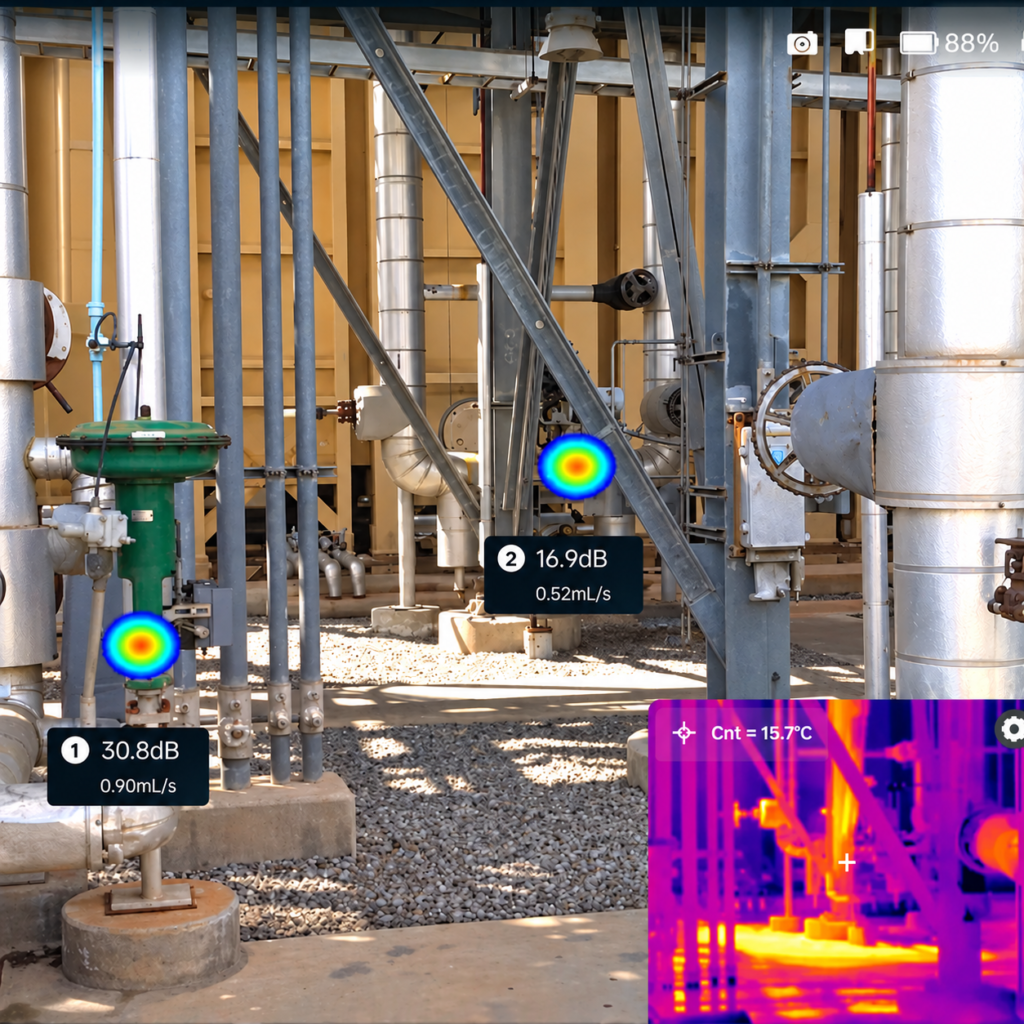
Sachu Technologies provides professional Acoustic Imaging & Air Leak Detection services across India for industrial plants, manufacturing facilities, utilities, substations, power plants, process industries and commercial facilities.
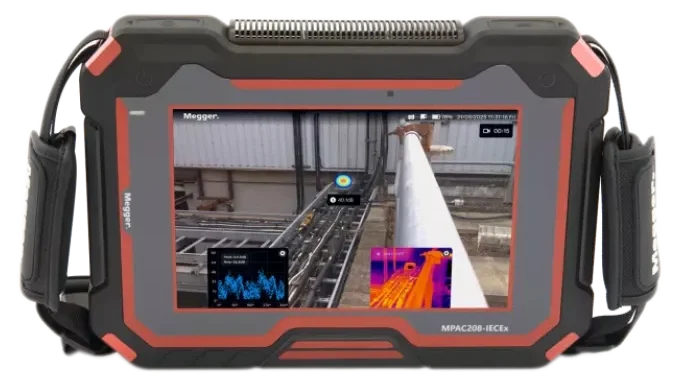
Acoustic imaging helps maintenance teams detect, locate and visualise acoustic and ultrasonic sources associated with compressed air leaks, suitable gas leaks and partial discharge activity. Therefore, it provides useful information for preventive maintenance, condition monitoring and fault investigation.
The technology allows technicians to scan large areas and identify suspected problem locations without checking every component individually. In addition, acoustic imaging can support inspections from a practical working distance where site conditions permit. As a result, maintenance teams can locate potential faults more efficiently and plan further inspection or corrective action.
Typical applications include compressed air leak detection, gas leak detection in suitable systems, pneumatic leak surveys, partial discharge pre-location and general condition monitoring.
Gas & Compressed Air Leak Detection
Sachu Technologies provides compressed air and gas leak detection services using acoustic imaging for suitable industrial applications.
Compressed air and gas leaks can occur at pipelines, joints, hoses, valves, couplings, regulators, fittings and other system components. Some leaks may be easy to identify. However, smaller leaks can remain difficult to locate, especially in large or noisy industrial facilities.
Acoustic imaging helps technicians scan accessible areas and locate acoustic emissions associated with suspected leaks. Instead of checking each connection individually, technicians can survey a wider area and then focus on identified locations.
Consequently, maintenance teams can locate suspected leaks, document their positions and plan appropriate corrective action.
Why Compressed Air Leak Detection Is Important
Compressed air plays an important role in many industrial processes. Facilities commonly use it for pneumatic tools, actuators, instrumentation, automation, cleaning and production equipment.
However, leakage can increase unnecessary compressed air demand. It may also cause compressors to operate more than required to maintain system demand.
Therefore, regular compressed air leak detection surveys can help maintenance teams identify leakage points and plan repairs. In addition, periodic surveys provide useful information about the condition of the compressed air distribution network.
After teams repair identified leaks, they can inspect the relevant areas again as part of their maintenance programme.
How Acoustic Imaging Helps Locate Air Leaks
Compressed air leaks can generate high-frequency acoustic or ultrasonic signals. Normal plant noise can make some leaks difficult to identify through hearing alone.
Acoustic imaging detects suitable acoustic signals and displays their location visually. Therefore, technicians can scan pipelines, fittings and equipment and then investigate areas that show possible leakage activity.
This method can be particularly useful in large industrial plants. For example, a manufacturing facility may have numerous pipelines, hoses, valves, joints and pneumatic connections across several production areas.
Instead of inspecting every connection individually, technicians can first scan wider areas. They can then focus their attention on locations that require further investigation.
Equipment & Areas Covered
Depending on the system, operating conditions and accessibility, acoustic leak detection can support inspection of:
- Compressed air pipelines
- Pipe joints and connections
- Flexible hoses and tubing
- Valves
- Couplings
- Regulators
- Filters and associated connections
- Manifolds
- Pneumatic components
- Flanges
- Connectors
- Fittings
- Suitable pressurised gas-system components
Because every facility has different equipment and operating conditions, the actual inspection scope depends on system accessibility, pressure conditions and customer requirements.
Benefits of Acoustic Air Leak Detection
Acoustic imaging can make industrial leak surveys more systematic and help maintenance teams focus on locations that require attention.
Key benefits include:
- Helps locate suspected compressed air leaks
- Supports detection of difficult-to-find leakage points
- Allows technicians to survey wider areas
- Helps identify leak locations from a practical working distance
- Supports maintenance planning
- Helps prioritise corrective action
- Documents suspected leak locations
- Supports preventive maintenance programmes
- Helps reduce avoidable compressed air losses after repairs
- Supports compressed air system management
- Provides information for follow-up inspections
However, actual benefits depend on the system condition, operating environment, identified leakage and corrective actions taken after the inspection.
Acoustic Imaging for Partial Discharge Pre-Location
Acoustic imaging can also support partial discharge pre-location in suitable high-voltage electrical equipment.
Partial discharge activity can produce acoustic or ultrasonic emissions. Therefore, acoustic imaging can help maintenance teams detect suitable emissions and identify their approximate source from a distance.
This information can help teams focus further investigation on specific equipment or areas. As a result, acoustic imaging can support condition-based and predictive maintenance programmes for electrical assets.
Depending on the equipment and inspection conditions, applications may include suitable:
- High-voltage electrical equipment
- Electrical substations
- Switchgear
- Outdoor electrical assets
- Insulation systems
- Electrical connections
- Other electrical equipment where detectable acoustic activity is present
Acoustic imaging primarily supports detection and pre-location in this application. Therefore, maintenance teams may need additional electrical diagnostic testing to assess suspected partial discharge activity in greater detail.
Acoustic Imaging for Preventive Maintenance
Acoustic imaging can provide useful information for preventive and condition-based maintenance programmes.
For example, maintenance teams can use acoustic imaging to identify suspected compressed air leaks, investigate abnormal acoustic activity and pre-locate possible partial discharge sources in suitable electrical equipment.
Moreover, technicians can survey larger areas and then focus further inspection on locations that show abnormal activity. This approach can make routine condition-monitoring surveys more focused.
Periodic acoustic imaging surveys can help organisations:
- Identify developing maintenance concerns
- Locate suspected air and gas leaks
- Support partial discharge pre-location
- Inspect large areas efficiently
- Document inspection findings
- Prioritise further investigation
- Plan corrective maintenance
- Support condition-based maintenance
- Compare findings during future inspections
Therefore, acoustic imaging can complement other inspection and condition-monitoring techniques used by industrial maintenance teams.
Industrial Applications
Acoustic Imaging & Air Leak Detection can support many industrial environments, including:
- Manufacturing plants
- Power plants
- Electrical substations
- Utilities
- Automotive industries
- Pharmaceutical facilities
- Food and beverage plants
- Steel and metal-processing facilities
- Cement plants
- Chemical and process industries
- Engineering industries
- Textile facilities
- Workshops
- Warehouses
- Commercial facilities
- Pneumatic production systems
- Industrial automation systems
When Should Acoustic Imaging Be Performed?
Facilities can consider acoustic imaging when they suspect compressed air or gas leakage, notice increased compressed air demand or need to inspect a large pneumatic network.
Similarly, electrical maintenance teams can consider acoustic imaging when they need to survey suitable electrical equipment for acoustic activity associated with possible partial discharge.
Periodic surveys can also form part of preventive or condition-based maintenance programmes. In addition, teams can repeat inspections after corrective work to review relevant areas under suitable operating conditions.
The inspection frequency depends on equipment condition, operating environment, maintenance strategy and site requirements.
Acoustic Imaging & Air Leak Detection Across India
Sachu Technologies provides Acoustic Imaging & Air Leak Detection services across PAN India for industrial plants, manufacturing facilities, utilities, substations, power plants and commercial facilities.
We support customers in major industrial locations, Hyderabad, Visakhapatnam, Vijayawada, Chennai, Puducherry, Trichy, Coimbatore, Hosur, Bangalore, Hubli, Mysore, Cochin, Kolkata, Pune, Goa, Mumbai, Thane, Kanpur, Jaipur, Nagpur, Delhi, Noida, Gurugram, Bhopal, Vadodara, Ahmedabad, Chandigarh, Tata Nagar, Raipur, Rudrapur, Durgapur, Kharagpur, Raigarh, Bhilai, Angul, Haldia, Jabalpur, Indore, Jamshedpur, Rajahmundry, Bokaro Steel City, Salem, Kochi, Rourkela, Jamnagar, Bharuch, Sri City, Nashik, Haridwar, Mathura, Aurangabad, Bhubaneswar, and other cities.
Our Approach
1. Requirement Review – We understand the plant layout, compressed air or pressurised system, inspection scope, operating conditions and reported concerns.
2. Inspection Planning – Accessible pipelines, equipment, joints, valves, hoses and other relevant components are identified for inspection.
3. Acoustic Survey – The selected areas are systematically scanned using suitable acoustic imaging techniques under appropriate operating conditions.
4. Leak Localisation – Acoustic sources associated with suspected leakage are investigated and their locations identified where practical.
5. Finding Documentation – Relevant observations and suspected leak locations are documented for maintenance reference.
6. Data Review – Inspection findings are reviewed and organised to support maintenance planning.
7. Reporting – A report is prepared with documented observations and identified locations to help the customer plan further assessment or corrective maintenance.
Frequently Asked Questions
1. What is Acoustic Imaging & Air Leak Detection?
Acoustic imaging is a non-contact inspection technique used to detect and locate sound or ultrasonic emissions associated with compressed air leaks and other suitable pressurised systems.
2. Why is compressed air leak detection required?
Compressed air leaks can increase unnecessary air demand and compressor loading. Leak detection helps maintenance teams identify leakage points and plan appropriate repairs.
3. Which equipment can be inspected for air leaks?
The inspection can cover compressed air pipelines, valves, hoses, couplings, fittings, regulators, manifolds, connectors and other accessible pneumatic system components.
4. Does acoustic air leak detection require a shutdown?
The relevant system generally needs to remain pressurised because escaping air produces the acoustic signal used for detection. Inspection conditions depend on the system and site requirements.
5. Does Sachu Technologies provide Acoustic Imaging & Air Leak Detection across India?
Yes. Sachu Technologies provides Acoustic Imaging & Air Leak Detection services across PAN India, including Hyderabad, Mumbai, Delhi, Bengaluru, Chennai, Pune, Ahmedabad, Kolkata, Gurugram, Noida and other industrial locations.
Find and Document Compressed Air Leaks in Your Facility
Schedule an Acoustic Imaging & Air Leak Detection survey with Sachu Technologies to identify suspected leakage locations and support planned maintenance across your compressed air system.